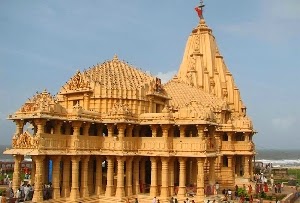
Somnath - this temple town has a long and chequered History. Even
though it is referred to by several other names, names it acquired in
the various phases of History, the name Somnath is unrivalled as far as
popularity is concerned. And understandably so because this small town
would have faded to oblivion but for the presence of the magnificent
Somnath Temple from which it receives its best known name.
Deo Pattan, Prabhas Pattan, Pattan Somnath (some of the other names of
this sea side town in Gujarat, India) would have all been erased from
public memory. But instead of that this place has made a distinctive
place for itself primarily because of this brilliant structure. The
History of Somnath (as in referring to the city) is so completely
dominated by the
History of Somnath Temple that it would not be exaggeration in the least to say that they are synonymous.
Not much is known about the early
History of Somnath temple.
However it is popularly believed that the first temple existed even
before the commencement of the Christian era. The second was built in
the period 480-767 A.D. by the Vallabhi kings. This was again replaced
by the Pratihara king Nagabhattta II in 815 A.D.
The Somnath temple which enshrines one of the twelve Jyotirlingas was
so highly revered that people from various nook and corners of the
country came to offer their prayers here.
As many as 2000 Brahmin priests were engaged in temple activities and
the revenue collected from ten thousand villages were used for its
maintenance. Prayers were announced by ringing the bell which was
attached to a golden chain. Its walls were nothing less than pages of
History. The exquisite sculptures were a reflection of the times and the
pillars even had the names of the sculptors carved on them.
Unfortunately what happened in the year 1025 was a very unfortunate event in the
Somnath temple history.
Muhammad of Ghazni invaded the city and in spite of the valiant
resistance put up by fifty thousand Shaivites, the temple was looted and
razed to the ground. What was regarded as an architectural masterpiece
was demolished brutally.
King Bhima of Gujarat and King Bhoja of Malwa then took upon themselves
the noble task of renovating this fine edifice in red sandstone.
However it was fated to be destroyed once again by Alaf Khan in 1300
A.D. This time King Mahipala belonging to the Chudasama dynasty
renovated it.
Thereafter also the History of Somnath is punctuated with episodes of
destruction and reconstruction at various points of time in the 14th,
15th and 16th centuries. Finally the temple was once again ruined in
1706 by Mughal Emperor Aurangzeb. After that more than two hundred years
passed before Sardar Vallabhbhai Patel finally took upon himself the
responsibility of constructing it once again in the year 1947. Much to
the glory and pride of not just Somnath but of the whole of India this
stunning temple was once again reincarnated. Presently this "Shrine
Eternal" is visited by a large number of pilgrims as well as by common
tourists. So without further delay you too can plan your Tour to Somnath
to witness this majestic temple.
Troubled times and Hindu Resilience in rebuilding the grat temple of Somnath :
This grand temple of Somanath came under the attack of the Muslims
several times. In the year 722, Junamad, the Sindh Subedar attacked it
for the first time and looted innumerable items from its treasure.
The beautiful statue of Somanath, can be seen from the center because
of the miraculous magnetic power. Ghajni Mohammed, destroyed this
statue on Friday, the 11th of May 1025 AD. From then onwards, Ghajni
Mohammed came to be known as the “Statute Destroyer” (Iconoclast). On
that day, he plundered and looted a treasure worth 18 crores.
In 1297 AD, Allauddin Kkhiji sent his Sardar Altaf Khan to Somanath
on a mission of destroying and putting down the Somanath Mandir. The
Somanath Temple was subjected to series of attacks starting in 1479 AD
by Mohammad Begada, Mujaffar Shah, II, in 1503 AD, and finally by
Aurangazeb, known to be the most intolerant towards other religions, in
1701 AD, where in, the temple was totally destroyed, plundered and
looted in a most horrible way. A large number of people were killed
mercilessly and a lot of money stolen.
In 1783 AD Sadhvi Alalya devi Holkar, a great devotee of Siva, built a
new temple for Somanath after India become independent, the lion of
Gujarat, Sardar Vallabhai Patel renovated the Somanath Temple on the
advice of Kakashaheb Gadgil of Maharashtra with its revived Indian
architectural beauty for which it became an unique example. It drew the
attention of the world.
The Somanath JyotirLinga statue was reinstated (Pran Pratishta) on
Friday the 11th May 1951 at 9.46 A.M. It was done by the then President
of India, Honourable Dr. Rajendra Prasad, to the tune of the Veda
chanting of Vedamurti Tarka Teertha Lakshman Shastri Joshi, in a grand
manner.
This primary JyotirLinga located in India, is the cynosure of all
Indian pilgrims. It is always crowded with lakhs of devotees. A large
number of Sadhus and pious men can be met there. With the offerings of
devotees, the Somanath Temple’s grandeur is revived. In spite of being
subjected to destruction by intolerants, the faith of Indian devotees,
dedication and their love was never destroyed. Shri Somanath JyotirLinga
stands as the legendary example of the same.
The temples 15th memorial and the ancient monument located on the sea
side of Kahiavad near Prabhaspattan. There are many famous mythological
stories attached to them. The sun temple is the most ancient of all.
There is no presiding deity in it, but the architecture of temple is so
exquisite, that even by seeing the ruins one can imagine.
Saint Agastya, is supposed to have drunk the entire sea near
Prabhasapattan. Mythological heroes like Janamejaya, Pandavas, Ravana
are supposed to have visited Prabhasapattan Teerth. In the month of
Magha (sometime in February) on the day of Shivaratri, Somanath
JyotirLinga festival is celebrated with great aplomb.
For More Information Contact:
www.btpyatra.com
https://www.facebook.com/btpyatra
Twitter : @btpyatra
http://www.waghobanagari.com/